PE Uniform Cost: A Per-Student Budget Guide for Schools
Every spring, someone in every district asks the same question: what should pe uniform cost per student actually be? The honest answer is a range — roughly $18 to $45 per student for a standard shirt-and-shorts set, depending on fabric, decoration, quantity, and how the program is structured. This guide breaks that range down line by line, shows where the money actually goes, and walks through the budgeting decisions that move a program from the top of the range to the bottom without making the uniforms feel cheap.
The Baseline: What a Standard PE Set Includes
For budgeting purposes, treat a PE uniform as a two-piece set: a short-sleeve tee or performance shirt with the school logo, plus mesh or performance shorts with a small logo or plain leg. Some programs add a third piece — a heavier tee for outdoor months, or reversible pinnies for team sports — but the two-piece set is the standard unit schools price against.
Three tiers cover nearly every program we see:
- Basic: cotton-blend tee, budget mesh short, one-color screen print. Durable enough, lowest cost.
- Standard: moisture-wicking poly-blend tee, performance short, one- or two-color print. The most common choice for middle and high schools.
- Premium: full performance knit shirt, pocketed performance short, multi-color or sublimated decoration, optional student names.
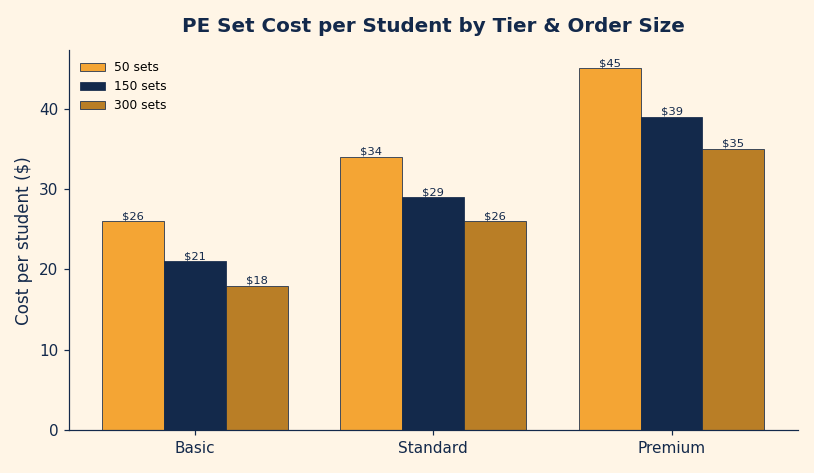
Notice how much the order size matters: a standard set that costs about $31 per student at 100 units drops to roughly $24 at 500. For multi-school districts, combining orders across campuses is the single largest lever on pe uniform cost — bigger runs amortize screens, art, and freight across more students without changing the garment at all.
Where the Money Actually Goes
When schools see a $28 per-student quote, the natural question is what’s inside that number. Here’s the typical breakdown for a standard-tier set at 250 units:
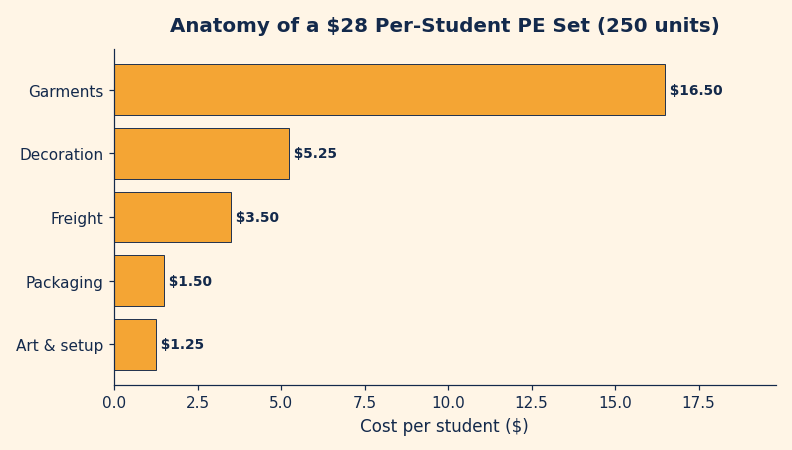
The garments themselves are roughly 60 percent of the cost, which carries a practical lesson: the fastest way to cut cost without hurting quality is rarely cheaper decoration — it’s smarter garment selection. Dropping from a name-brand performance tee to an equivalent-spec private-label blank often saves $3 to $5 per student with no visible difference in the gym.
Line-Item Budget Table
Use this as a starting template for a 250-student order, standard tier:
| Line Item | Per Student | 250 Students | Notes |
|---|---|---|---|
| Shirt (performance blend) | $9.50 | $2,375 | Private-label blank |
| Shorts (mesh/performance) | $7.00 | $1,750 | Plain leg saves ~$1.50 |
| Decoration (2 locations) | $5.25 | $1,312 | 1-color screen print |
| Art & screen setup | $1.25 | $312 | Waived on reorders |
| Size packs & polybagging | $1.50 | $375 | Optional but saves staff hours |
| Freight | $3.50 | $875 | Ground, non-rush |
| Total | $28.00 | $6,999 |
Who Pays: Three Funding Models
The same uniform can hit three different budgets depending on program structure. Student-purchase programs pass cost to families, often through the bookstore with a $25 to $40 retail price; simple, but collections and sizing chaos land on PE staff. School-funded programs buy uniforms outright and either issue or loan them; cleanest for equity, hardest on the budget line. Hybrid models — school buys, families pay a reduced activity fee, hardship waivers built in — have become the most common structure in public districts because they smooth both problems. Whichever model you choose, lock it before you order: student-purchase programs need individual polybagging and size exchanges, while school-funded programs need numbered inventory and a laundering plan, and those specs change the quote.
The Costs Nobody Budgets For
Four line items routinely surprise first-year program coordinators. Replacement stock, because ten to fifteen percent of students will need a replacement or size swap mid-year. Rush fees, which add 15 to 25 percent when orders release after the August crunch begins. Name personalization, at $2 to $4 per garment, which sounds small until it’s multiplied by 400 students. And art changes: a redesigned school logo means new screens and new embroidery digitizing, so time rebrands to natural reorder cycles. Building a 10 percent contingency into year-one budgets absorbs all four.
Getting the Number Down Without Feeling Cheap
The programs that hit the low end of the range do the same five things: they combine campuses into one order, choose private-label blanks over brand names, keep the logo to one print color, decorate one location on shorts (or none), and reorder on a two-year cycle instead of annually by keeping a consistent design. None of those choices are visible to a parent watching a PE class from the bleachers. What is visible is fit and fabric — which is why we recommend spending the savings on the standard tier’s moisture-wicking upgrade before anything cosmetic. Decoration method matters too; our companion guide to PE uniform printing methods covers exactly when screen printing, heat transfer, and embroidery each earn their cost.
At Peuniforms we quote school programs as itemized budgets, not lump sums, so you can see and adjust every line above before ordering. Learn more about how we work with districts on our about page, or browse more planning guides on the blog.
Get an Itemized PE Uniform Quote
Tell us your headcount and tier, and we’ll return a line-item budget with quantity pricing across all three tiers — free, within one business day.
Get a Quote