When schools spec PE shirts, the moisture-wicking vs cotton question is usually the one that decides the budget. Both fabrics work, but they hold up differently, feel different in a gym, and land at different price points. For an athletic director or PTA buyer trying to make a uniform order last, knowing which fabric fits your program saves money over the year. Here is a clear, no-hype comparison of moisture-wicking and cotton-blend PE shirts.
The two fabrics, defined
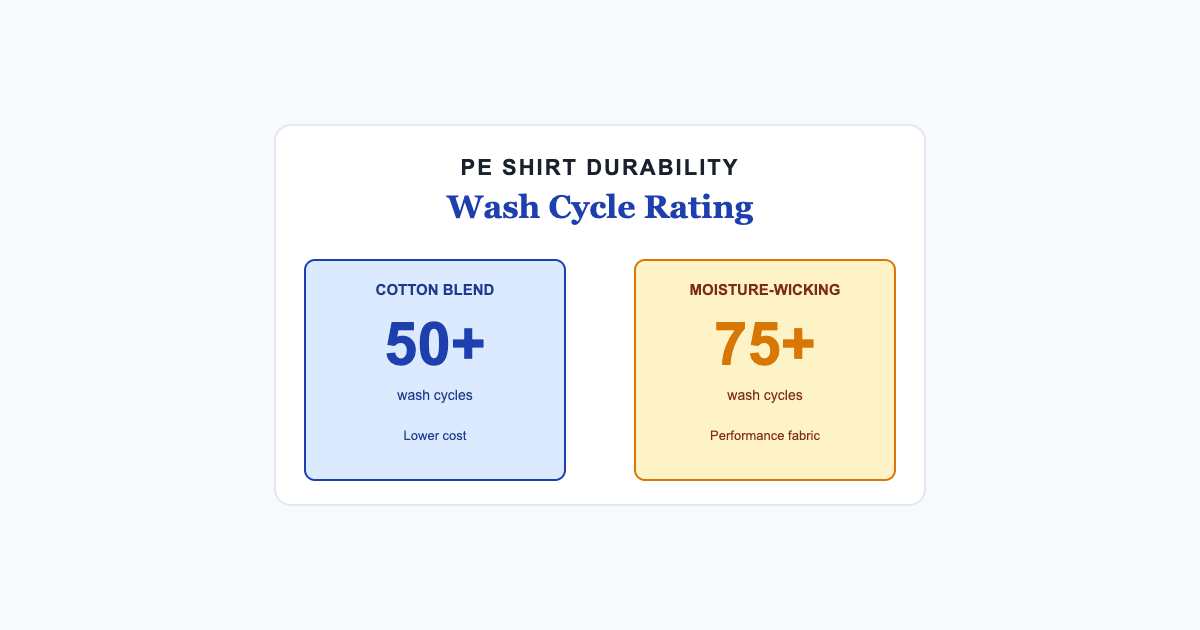
A cotton-blend PE shirt is typically a polyester-cotton mix. It has a soft, familiar feel, takes printing well, and is the lower-cost option for most programs. Our standard blend is rated for 50 or more wash cycles, which covers a typical school year of regular laundering.
A moisture-wicking shirt uses a performance fabric engineered to pull sweat away from the skin so it evaporates faster. It feels lighter during activity and dries quicker between classes. Our moisture-wicking fabric is rated for 75 or more wash cycles, so it tends to outlast the blend in the laundry over time.
Durability: which lasts longer in the wash
On wash durability alone, the moisture-wicking fabric has the edge, rated for 75-plus cycles against the blend’s 50-plus. For a uniform that gets washed constantly, those extra cycles translate into a longer service life before colors fade or fabric thins.
That said, the cotton-blend’s 50-plus rating still comfortably covers a school year of normal use. If shirts are replaced annually anyway, the blend’s durability may be all a program needs, and the higher performance rating is capacity you would not use.
Match durability to your replacement cycle
The practical question is not which fabric lasts longest in the abstract, but how your replacement schedule lines up with each rating. Programs that keep shirts for multiple years lean toward moisture-wicking; programs that reissue every year often do fine with the blend.
Comfort and performance in the gym
Moisture-wicking shirts feel cooler and lighter during activity, which students notice on high-effort days. The fabric moves sweat off the skin, so the shirt feels less heavy and damp by the end of class. For programs with intense activity or warm gyms, that comfort is the main reason to upgrade.
Cotton-blend shirts feel soft and broken-in from day one and are perfectly comfortable for general PE. For lower-intensity classes or younger grades, the difference in activity feel is smaller, and the blend’s familiar comfort is a fine fit.
Cost and cost-per-wear
The cotton-blend is the lower upfront cost, which matters when you are outfitting an entire school on a fixed budget. Moisture-wicking carries a higher per-shirt price but a longer wash life, so over multiple years the cost-per-wear can narrow. Our breakdown of PE uniform sizing pairs well with this decision, since ordering the right sizes the first time also protects the budget.
Run the math against your own replacement cycle: upfront cost matters most if you reissue yearly, while cost-per-wear matters more if shirts stay in service for several years.
Care: keeping either fabric in service
Both fabrics last longer with simple laundering habits: wash in cold water, avoid high heat in the dryer, and skip fabric softeners on the performance fabric since they can coat the fibers and reduce wicking. Printed logos also hold up better with cooler wash and dry cycles. Communicate basic care guidance to families and your uniforms will hit their rated wash counts.
Which to choose for your program
Choose the cotton-blend when budget is the priority, activity is general, and shirts are reissued on a regular cycle. Choose moisture-wicking when comfort during high activity matters, you want the longer wash life, or you keep uniforms in service across multiple years. Many schools split the difference and run the blend for general PE while reserving performance fabric for athletics or specific programs.
If you are mapping out a full order, our guide on how to order school PE uniforms walks through the process from size breakdown to artwork.
Bringing it together
The moisture-wicking vs cotton-blend decision comes down to your budget and your replacement cycle: the blend is the cost-effective workhorse rated for 50-plus washes, while moisture-wicking offers cooler comfort and a 75-plus wash life for programs that keep shirts longer. Pick the one that matches how your school actually uses and replaces its uniforms. Browse our PE shirts and mesh shorts to compare options.
Ordering for next school year? Send us your size breakdown and we will get a quote back within one business day, with purchase orders and net-30 terms welcome.
GET A QUOTE