PE Uniform Printing: Screen Print vs Heat Transfer vs Embroidery
Choosing the right pe uniform printing method matters more than most athletic directors expect. The same shirt and shorts can look crisp for four years or crack by winter break, depending entirely on how the school logo was applied. This guide compares the three main decoration methods for PE uniforms — screen printing, heat transfer, and embroidery — across durability, cost, appearance, and turnaround, so you can pick the right method for each garment before you sign off on a program order.
The Three Methods, in Plain Terms
Screen Printing
Ink is pushed through a mesh stencil directly onto the fabric, one screen per color, then cured with heat. It’s the workhorse of school apparel: bold color, soft feel when done well, and extremely low per-piece cost at volume. Setup carries a fixed cost per color, which is why one- and two-color school logos are the standard for PE programs.
Heat Transfer
Designs are cut from vinyl (HTV) or printed digitally, then bonded to the garment with a heat press. Transfers shine for names, numbers, and small-batch or mixed-size orders because there are no screens to burn. The trade-off is longevity: transfers sit on top of the fabric, so repeated industrial washing eventually lifts edges and cracks large solid areas.
Embroidery
The logo is stitched directly into the fabric with polyester thread. It’s the most durable and most premium-looking option, and it never cracks or fades. But on lightweight performance knits, dense stitching can pucker, and on garments that sit against skin during exercise, a big stitched patch can chafe. That’s why embroidery on PE gear is usually reserved for polos, jackets, and staff wear rather than practice tees.
Durability: The Number That Should Drive the Decision
PE uniforms live a harder life than fan-wear. A garment worn twice a week and washed forty-plus times a year needs decoration that survives industrial laundering. Here is how the methods compare on wash-cycle life before visible degradation:
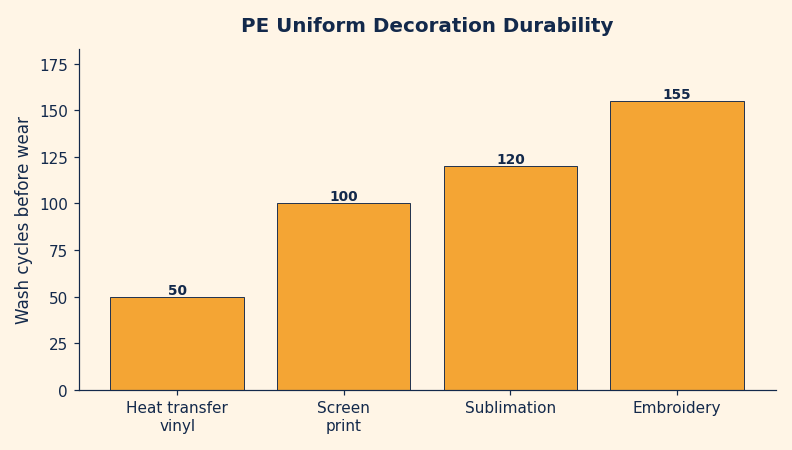
Two notes on reading that chart. First, quality ranges are wide: a properly cured plastisol print can double the life of a rushed one, which is why supplier quality matters as much as method. Second, sublimation — dyeing the design into polyester fabric itself — is included because it’s increasingly common on all-polyester PE shirts; it can’t crack or peel because there’s nothing sitting on the surface, but it only works on light-colored polyester.
Cost per Garment: What Schools Actually Pay
Decoration cost depends on method, colors or stitch count, and quantity. The chart below shows typical per-garment decoration costs (decoration only, garment not included) at a common school order size of 200 pieces.
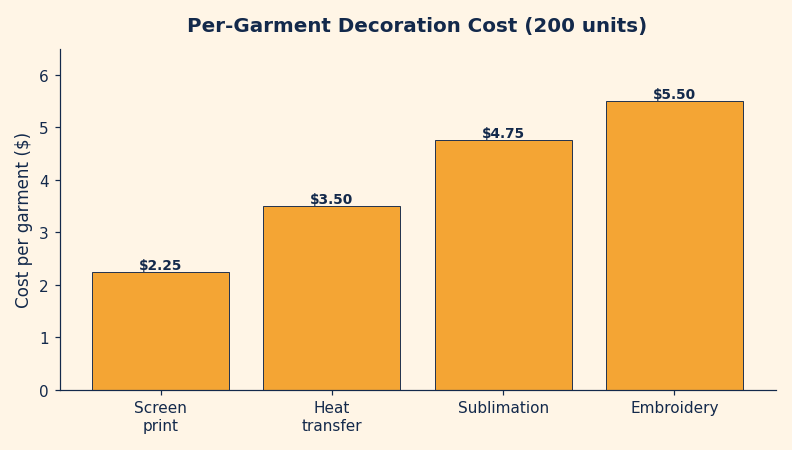
At smaller quantities the picture flips: below roughly 36 pieces, heat transfer often beats screen printing because there are no screen setup fees to amortize. That’s why reorders, replacement sizes, and name personalization are commonly done with transfers even when the main order was screen printed.
Side-by-Side Comparison
| Factor | Screen Print | Heat Transfer | Embroidery |
|---|---|---|---|
| Best at | Large runs, 1–2 color logos | Names, numbers, small batches | Polos, outerwear, staff gear |
| Feel on performance fabric | Soft to moderate | Moderate; large areas can feel plasticky | Raised; can pucker thin knits |
| Wash life | ~100 cycles | ~50 cycles | 150+ cycles |
| Setup cost | Per color/screen | Minimal | One-time digitizing |
| Typical turnaround | 2–3 weeks | 1–2 weeks | 2–3 weeks |
How Fabric Choice Changes the Answer
Decoration and fabric are a system. On 100% polyester performance knits, standard plastisol inks need careful temperature control to avoid dye migration — the effect where a red shirt bleeds pink into a white logo. Suppliers handle this with low-bleed inks and lower cure temperatures. On cotton-rich blends, everything prints easily but the garment itself weighs more when wet. Sublimation requires polyester and works best on white or light garments, which is why fully sublimated PE shirts usually build the school color into the design rather than the blank. If you’re still choosing garments, decide fabric first and decoration method second, and confirm your printer has experience with your specific blank.
Art Files: The 15-Minute Task That Saves Weeks
Whatever pe uniform printing method you choose, the artwork file determines the quality ceiling. Send vector art (AI, EPS, or PDF with outlined text) rather than a screenshot of the school website. For embroidery, the logo must be digitized — converted into a stitch file — which is a one-time cost of $40 to $80 that your supplier keeps on record for every future order. Simplify fine detail: thin outlines under 1.5 mm disappear in stitching and clog in small screen prints. A cleaned-up, simplified athletic mark almost always outperforms the full official crest on a gym shirt.
Making the Call for Your Program
Here’s the fast decision path we give athletic directors. If you’re ordering 100+ identical tees and shorts with a one- or two-color logo: screen print. If you need under three dozen pieces, mixed reorders, or student names: heat transfer. If it’s a polo, jacket, or anything staff wears daily: embroidery. If you’re going all-polyester and want a design that can never crack: sublimation. Most schools land on a mix, and a supplier like Peuniforms will spec each garment in the program accordingly — you can read how we work with schools on our about page.
Decoration is only half the ordering decision, of course. For the full budget picture — garment costs, program tiers, and per-student math — see our companion guide to what PE uniforms cost per student, and browse more program-planning guides on the blog.
Get Your School Logo on the Right Uniform, the Right Way
Send us your logo and headcount and we’ll recommend the decoration method for each garment, with school pricing and a free art proof.
Get a Quote