Sizing a School PE Uniform Program: Youth-to-Adult Runs
Ordering PE uniforms for a whole school sounds simple until the boxes arrive and you discover forty extra smalls and not a single 2XL. Good pe uniform sizing is really a forecasting problem: predicting how a real student body spreads across youth and adult sizes, ordering to that curve, and keeping enough buffer for the students who never fit the average. Get it right and distribution is calm; get it wrong and you spend the first month of school chasing replacements while some students go without.
This guide covers how to plan pe uniform sizing for a school program: how sizes typically distribute across a grade range, how to build a size run that matches your students, and how to set up a reorder cycle so you are never caught short mid-year.
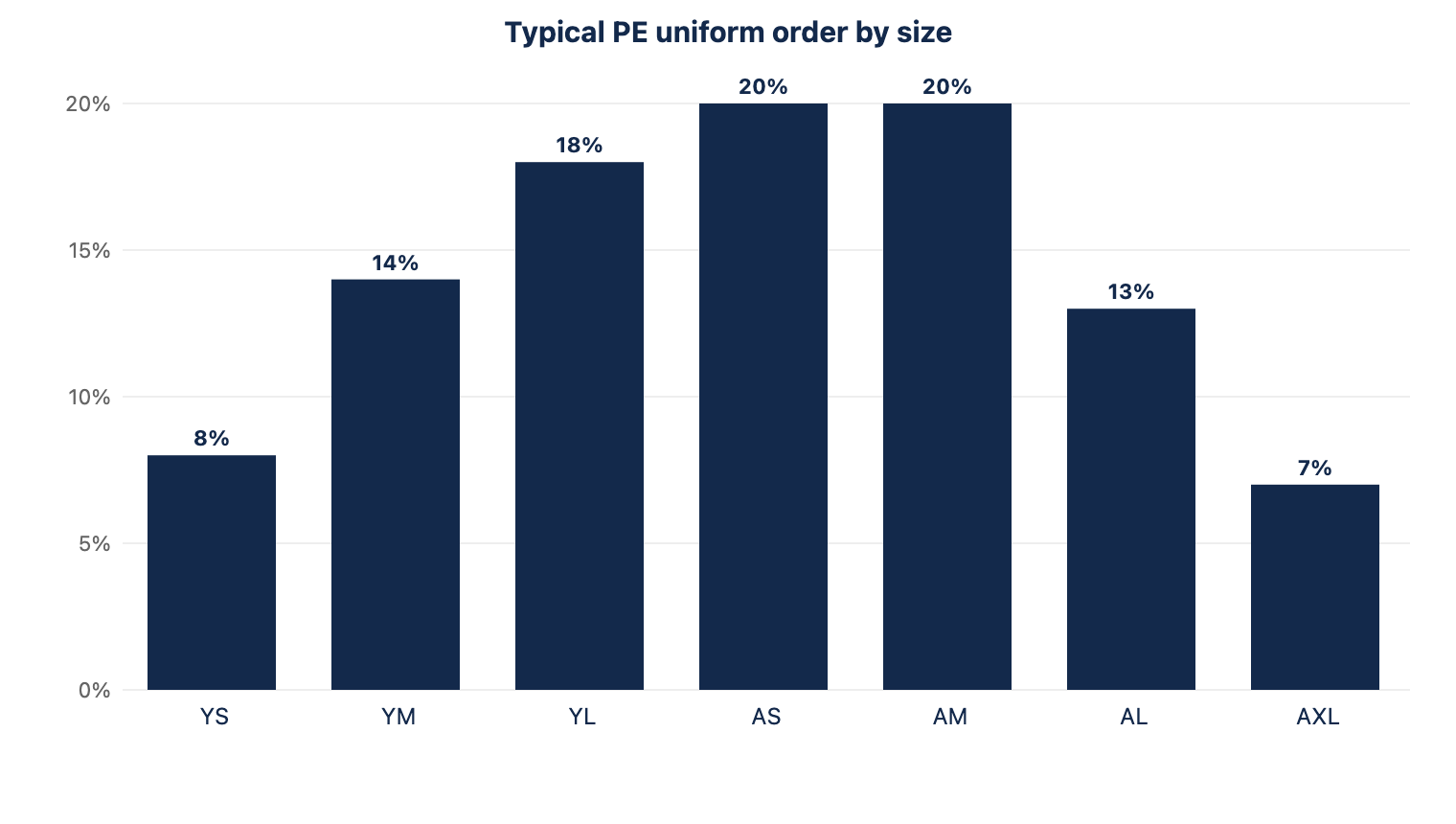
Sizing is a distribution, not a guess
The mistake schools make is ordering equal quantities of each size. Real student bodies cluster: a middle school skews toward youth and small adult sizes, a high school toward adult mediums and largers, with a meaningful tail at both extremes. Ordering to that bell-shaped curve, heavier in the middle, lighter but never zero at the ends, means most students get a good fit on day one. The chart above shows a representative spread you can adapt to your school’s age range.
Youth versus adult transition
The trickiest zone is the youth-to-adult transition, roughly the middle-school years, where students of the same age can span several sizes. Rather than forcing everyone into adult sizing or youth sizing, order across both ranges through that band so a small sixth-grader and a tall eighth-grader are both covered. Offering both a youth large and an adult small, which overlap, gives borderline students a comfortable choice instead of an awkward compromise.
Building your size run
A size run is simply the quantity you order of each size. Start from your enrollment and age range, apply a distribution curve like the one above, then adjust for what you know about your specific population. Athletic programs and certain regions skew larger; younger or smaller cohorts skew down. If you have prior years’ data, use it, your own history is the best predictor you have. Round toward the middle sizes when unsure, since those move fastest and are easiest to reuse.
Buffers and the sizes you always run short on
Every program runs short on the extremes, the smallest youth and the largest adult sizes, because they are hardest to predict and easiest to under-order. Build a deliberate buffer at both ends rather than a flat percentage across the board. New enrollments, growth spurts mid-year, and replacements for damaged uniforms all draw down the tails first. A modest surplus of the hard-to-fit sizes prevents the situation where a single student cannot be outfitted at all, which is far worse than a few leftover mediums.
| Size band | Order weight | Buffer priority |
|---|---|---|
| Youth S-M | Light-moderate | Medium |
| Youth L / Adult S | Moderate | High (transition) |
| Adult M-L | Heaviest | Low (fast-moving) |
| Adult XL+ | Light | High (runs short) |
Setting up a reorder cycle
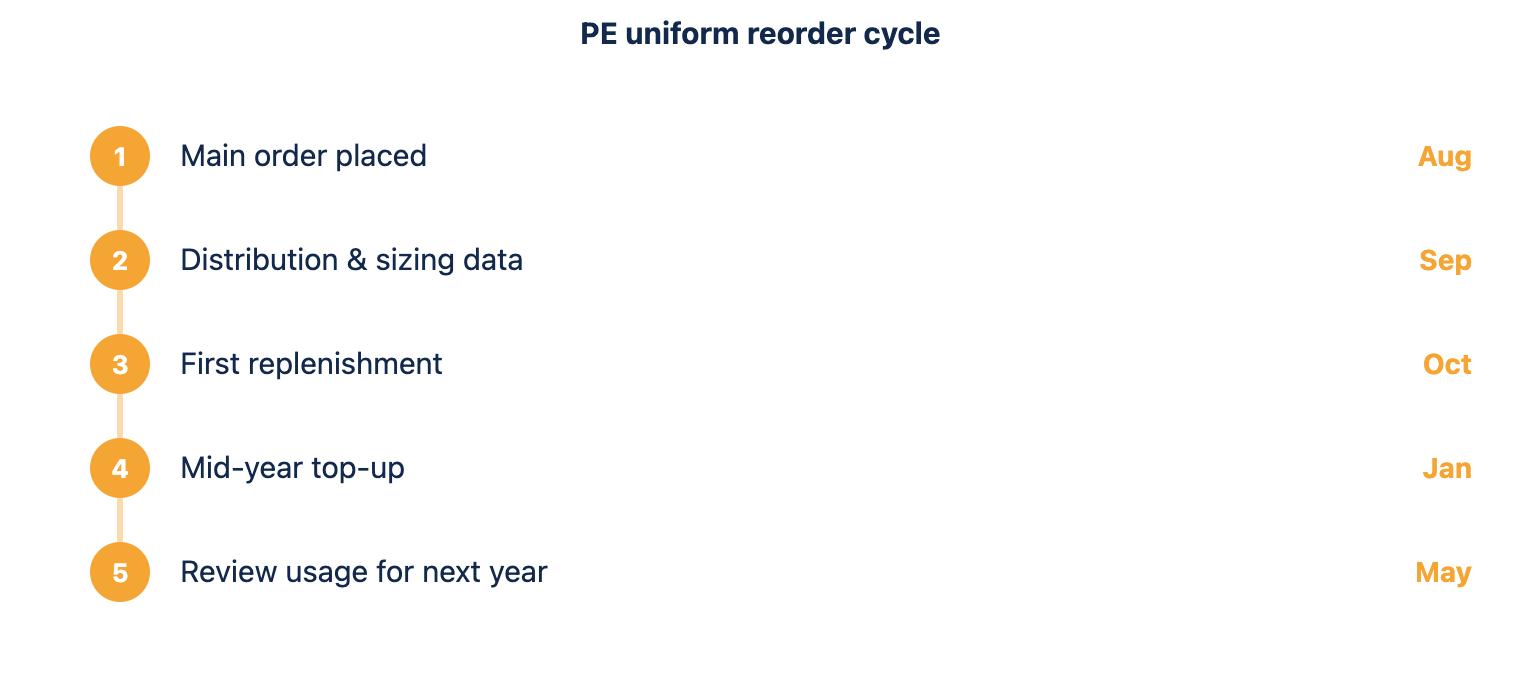
A one-time order at the start of the year almost guarantees a mid-year shortage. Instead, plan a reorder cycle: a main order before the school year, a smaller replenishment a couple of months in once real demand is visible, and a standing arrangement for quick restocks. Keeping your design and colors on file with your supplier makes each reorder fast and consistent, so a top-up never means starting the design process over. The timeline above shows a rhythm that keeps shelves stocked without tying up budget in excess inventory.
Tracking what you actually use
The best data for next year is this year. Track which sizes you distribute and which run out first, and that record becomes a far more accurate forecast than any generic curve. Over two or three years, a school builds a size profile specific to its population, turning uniform ordering from a guessing game into a routine reorder. A simple spreadsheet updated at each distribution is all it takes.
Handling growth and mid-year changes
Students grow, especially through the middle grades, and a uniform that fit in September may be tight by spring. Anticipate this by leaning slightly toward the next size up for borderline younger students and by keeping the mid-year top-up specifically stocked for the sizes growth pushes students into. New enrollments arriving throughout the year draw from the same buffer, so treating growth and new students as a single ongoing demand, rather than a surprise, keeps you from scrambling. A small standing reserve of the fastest-growing bands covers most of these mid-year needs.
Loaner and replacement stock
Keep a small pool of loaner uniforms in common sizes for students who forget theirs, lose one, or are waiting on a replacement. A modest loaner set prevents a forgotten uniform from becoming a reason a student sits out class, which protects participation. Wash and recirculate these between uses, and replenish the pool from your regular reorder so it never dwindles to nothing right when it is needed most.
Distribution logistics
How uniforms reach students matters as much as the order itself. Pre-sort by size and, where possible, by class or grade before distribution day so lines move quickly. Offer a simple exchange window for students who need a different size, since even a good size run produces a few mismatches. Building in that exchange step up front prevents the slow trickle of one-off fit problems from dragging on for weeks and keeps both students and staff from frustration.
Bottom line
Smart pe uniform sizing treats the order as a distribution to forecast, not a guess: order to a bell curve weighted toward the middle, buffer the hard-to-fit extremes, plan a reorder cycle instead of a single bulk buy, and track your real usage to sharpen next year. Do that and every student gets a uniform that fits, without a closet full of leftover sizes.
Plan your PE uniform size run
Share your enrollment and grade range and we will build a size run and reorder plan that fits your school.
Get a QuoteHome · About · Buying guides · Companion guide: PE uniform fabric